


|
|
|
Conference Partners |
 |
|
FFF General Partner |
|
|
|
FF26 Partners |
|
|
|
FFF Partner
FFF R&D Partner
|
|
Mobility Partner |
|
|




- DATE: 21–23 October 2026
- VENUE: PVA EXPO PRAGUE
- OFFICIAL LANGUAGE: English
- CONFERENCE PROGRAMME
- CONFERENCE FREE REGISTRATION
- Event is part of the Future Forces Exhibition & Forum 2026
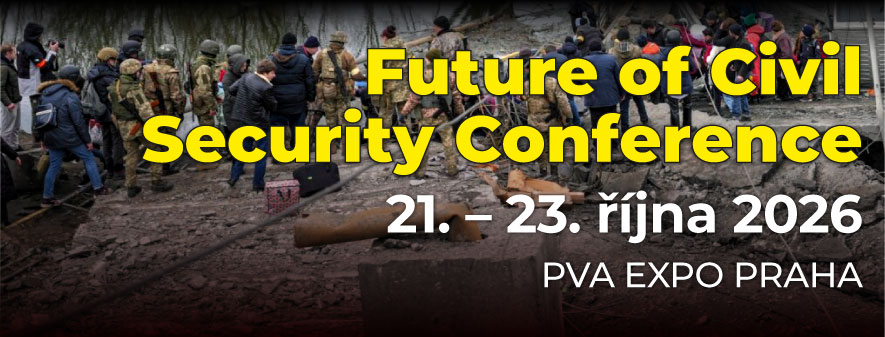
Organization and Provision of Civil Security in Wartime
The 2nd Future of Civil Security (FCS) Conference brings together representatives of administrative authorities, Ukraine's security sector, civil society organisations, and international experts to share experience in:
- Safeguarding civilian populations
- Restoring damaged and destroyed infrastructure
- Organising evacuation efforts and providing assistance to affected populations
- Civil-military cooperation in crisis conditions
The conference will also address the establishment and development of relations between Ukrainian partners, the EU, NATO, and other cooperating nations. The Future Forces Forum 2026 will further be attended by representatives of Ukraine's military administrations and local self-government bodies who have been directly affected by armed conflict involving Russian forces, and who have organised the evacuation of populations to safe areas in crisis situations.
Co-organisers
- International Academy of Civil Security and Cooperation (IACSC)
- Ukrainian Association of Defense Industry and Security (UADSI)
- Defence and Security Industry Association of the Czech Republic (AOBP)
Proposed Topics
European Commission - Directorate-General for European Civil Protection and Humanitarian Aid Operations (DG ECHO)
- Union Civil Protection Mechanism in Ukraine, and the lessons learned from our support over the last years
Ministry of Internal Affairs (MIA)
- Cooperation with local communities in supporting and accompanying evacuated populations during military operations and critical conditions
- Cooperation with local communities regarding the protection of institutions, enterprises, and property
- Cooperation between local communities and foreign organizations regarding the evacuation of children and family members, including their reception, accommodation, transportation, and the provision of essential humanitarian assistance
State Border Guard Service of Ukraine (SBGSU)
- Mass movement of persons across the state border of Ukraine under martial law
- Issues and specific features of illegal migration during martial law
State Emergency Service of Ukraine (SESU)
- Critical infrastructure protection during martial law
- Challenges faced by Ukraine since the onset of Russian armed aggression
National Guard of Ukraine (NGU)
- Participation of NGU units in ensuring stability in de-occupied territories and cooperation with local self-government bodies
- Interaction with local government bodies during states of emergency and combat operations
Additional Topics of Representatives of Municipalities, State-owned Enterprises and Institutions, Civil Society Organizations and Public Institutions
- The role of non-governmental entities in organising resistance, ensuring the viability of administrative territories of Ukraine, restoring infrastructure, and the functioning of liberated territories
- Roles and responsibilities of city and regional leadership under occupation and in liberated territories
- Education in schools and educational institutions during martial law
- Evacuation of the population from active combat zones
- Critical energy infrastructure in the context of modern warfare: lessons for the Eastern flank of NATO and the EU
- The Black Sea: the problem of demining in areas of commercial navigation and coastal zones
- Mobilisation activities and employee deferment procedures for staff at energy sector enterprises
- Specific features of uninterrupted functioning and safety measures for medical institutions during martial law, including protection of personnel and visitors
- Methods and technologies for protecting critical infrastructure
- Organisation and operation of resilience centres and bomb shelters
- Training of drone operators for civilian protection, military reserve support, and vocational retraining
- Readiness of medical institutions for critical conditions, including medicine stockpiling and coverage of specialties by department
- Civil evacuation and support for internally displaced persons (IDPs):
- Accommodation and employment support for IDPs
- Medical and psychological assistance for evacuated populations
- Modular housing and evacuation centres; requirements for shelters and equipment
- Field water purification systems
- Innovative drone technologies in military-civil cooperation, including their use and capabilities in coordination and assistance during emergencies and war
- From evacuation to recovery: digital infrastructure for civil support at the community level, including a platform for coordination in crisis zones
- Ensuring the functioning of critical city infrastructure under occupation and during missile and drone attacks, as well as its restoration
- Psychological support for the civilian population
- Public warning systems and protocols for air raids and other emergencies
- Countering enemy disinformation and keeping the population informed
- Peculiarities of public utility services' operations under critical conditions and during missile and drone attacks
Additional topics may be incorporated into the conference agenda based on the interests and proposals of representatives from security services, civil administrations, industry, innovation, research and development organisations.
CONFERENCE PROGRAMME
| WEDNESDAY | |
| WELCOME REMARKS | |
| 13.00 | Mr. Andrius Kubilius, Commissioner responsible for defence and space, European Commission |
| Mr. Vasyl Zvarych — Ambassador Extraordinary and Plenipotentiary of Ukraine to the Czech Republic | |
| Mr. Yevhen Krupa, President of the International Academy of Civil Protection and Cooperation | |
| MG Serhii Kryvonos — Vice President of the International Academy of Civil Security and Cooperation | |
| TBD, Directorate-General for European Civil Protection and Humanitarian Aid Operations (DG ECHO) | |
| distinguished guests, (USA, Canada, UK) — TBC | |
| Mrs. Christine Dugoin-Clément, Research Fellow at the Risk Department of IAE Paris-Sorbonne Business School, the Observatory of Artificial Intelligence and the French National Gendarmerie Academy (AMGN) | |
| Mrs. Karolin Rillo, International Visits Specialist, International Relations Department, Tallinn City Government | |
| Mr. Tomáš Kopečný — Former Deputy Minister of Defence of the Czech Republic, former Government Commissioner for the Reconstruction of Ukraine, Head of the Department of the International Academy of Civil Security and Cooperation. | |
| PRESENTATIONS | |
|
13.25 |
Directorate General for European Civil Protection and Humanitarian Aid Operations (DG ECHO) Discussion, Q&A |
|
13.50 |
Kherson Regional Military Administration Discussion, Q&A |
|
14.10 |
All-Ukrainian Association of Local Self-Government Authorities of Ukraine, Chernihiv Regional Branch Discussion, Q&A |
|
14.35 |
State Energy Supervision Inspectorate of Ukraine |
|
14.55 |
Poltava District Administration |
|
15.35 |
Coffee Break |
|
15.50 |
State Border Guard Service of Ukraine |
|
16.10 |
State Border Guard Service of Ukraine |
|
16.30 |
European Border and Coast Guard Agency |
|
16.50 |
National Guard of Ukraine |
|
17.10 |
State Emergency Service of Ukraine (SESU) |
|
17.20 |
State Emergency Service of Ukraine (SESU) |
|
17.40 |
Discussion, Q&A |
|
|
THURSDAY |
|
|
WELCOME REMARKS |
|
9.30 |
Mr. Viesturs Kleinbergs, Mayor of Riga |
|
9.40 |
Global Alliance for Information and Communication Technologies and Development at the United Nations |
|
10.00 |
Risk Department of IAE Paris-Sorbonne Business School (Université Paris 1 Panthéon-Sorbonne) |
|
10.20 |
International Academy of Civil Safety and Cooperation |
|
10.35 |
Institute of Psychology of the Czech Academy of Sciences |
|
10.55 |
Academy of Critical Thinking (Slovakia) |
|
11.10 |
Coffee Break |
|
11.20 |
Silver B (United Kingdom) |
|
11.40 |
Odesa National University |
|
12.00 |
Servionix GmbH Discussion, Q&A |
|
12.25 |
National Police of Ukraine |
|
12.45 |
National Police of Ukraine |
|
13.05 |
National Police of Ukraine Discussion, Q&A |
|
13.30 |
Lunch |
|
14.20 |
Uman District Council of Cherkasy Region |
|
14.40 |
Odesa City Council |
|
15.00 |
Uman District Council of Cherkasy Region |
|
15.20 |
Centre for Global Studies “Strategy XXI” |
|
15.40 |
Centre for Global Studies “Strategy XXI” Discussion, Q&A |
|
16.05 |
Coffee Break |
|
16.20 |
Uman District Council of Cherkasy Region |
|
16.40 |
Hrodna City Council |